Autonomous AI Development Studio
Build software with your own autonomous AI development team.
Describe what you want to create. PWR plans, builds, tests, reviews and improves your software with a coordinated team of AI agents.
PWR is in early access. For software applications and games.
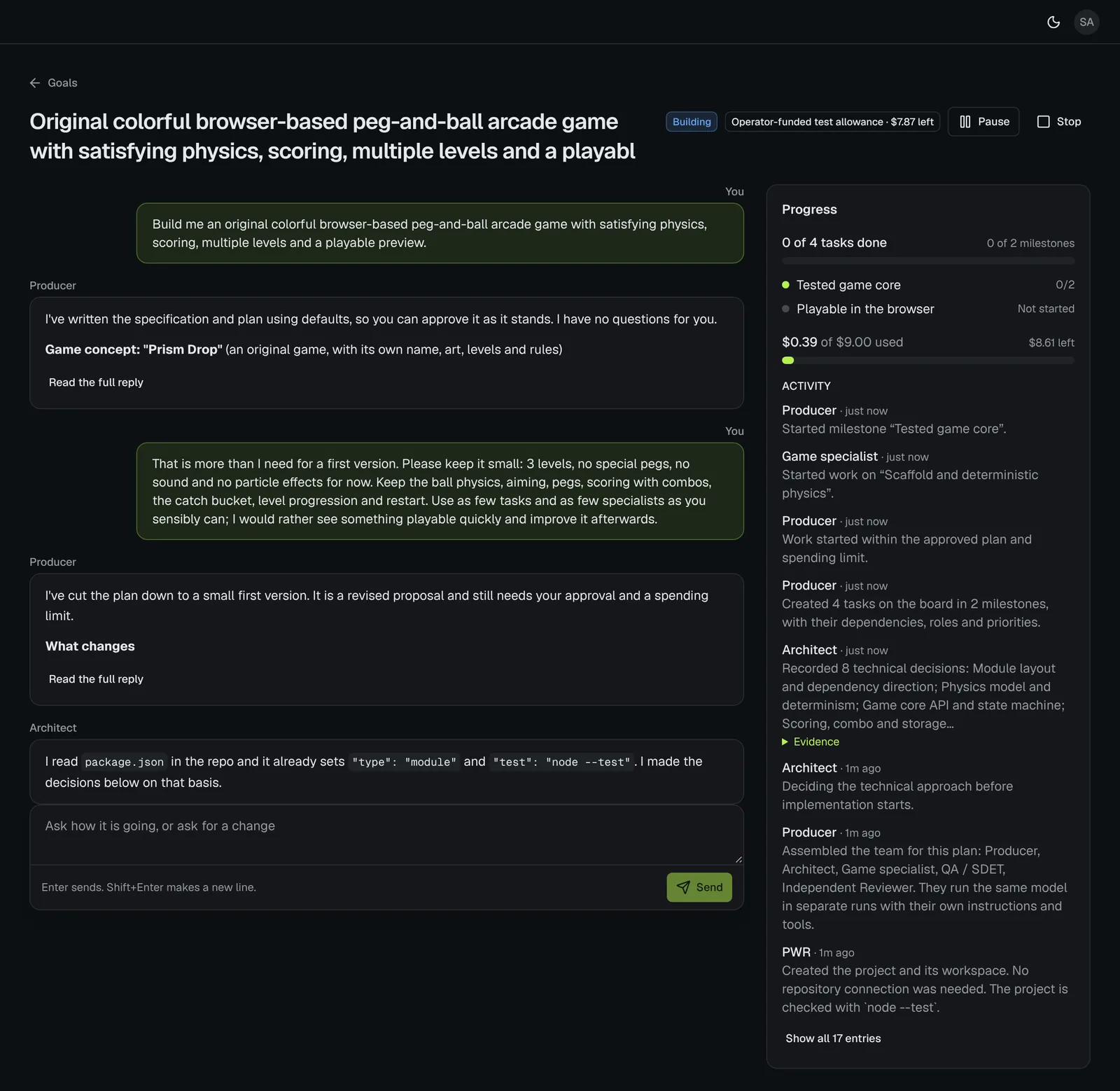
How PWR works
From an idea to working software, in six steps.
You stay in charge of what gets built and what it may cost. PWR does the development work in between.
- Step 1
Describe
Tell PWR what you want to build, in your own words.
- Step 2
Plan
The Producer clarifies what you need, recommends the technology and prepares a development plan.
- Step 3
Approve
Review the scope and the tasks, and set a spending limit. Nothing is built before you approve.
- Step 4
Build
PWR assembles specialist agents and they implement the plan, task by task.
- Step 5
Validate
QA and an independent reviewer look for problems, and the work goes back until they are fixed.
- Step 6
Improve
Look at what was delivered, say what you want changed, and development continues.
A real build
From an idea to a working browser game.
A real run on PWR staging, recorded on 11 November 2026: one request, an approved plan, an AI development team handling implementation, QA, review and a revision.
What the customer typed
“Build me an original colorful browser-based peg-and-ball arcade game with satisfying physics, scoring, multiple levels and a playable preview.”
- Tasks in the approved plan
- 4, in 2 milestones
- Agent runs
- 27
- Findings raised
- 15 by QA, 6 by review; none left open
- Start to delivery approval
- About 12 minutes
- Recorded cost
- $2.11 of a $9.00 limit
- 01
One sentence in
The customer typed a single request. No repository was connected and no project was set up by hand; PWR created the project and its workspace.
- 02
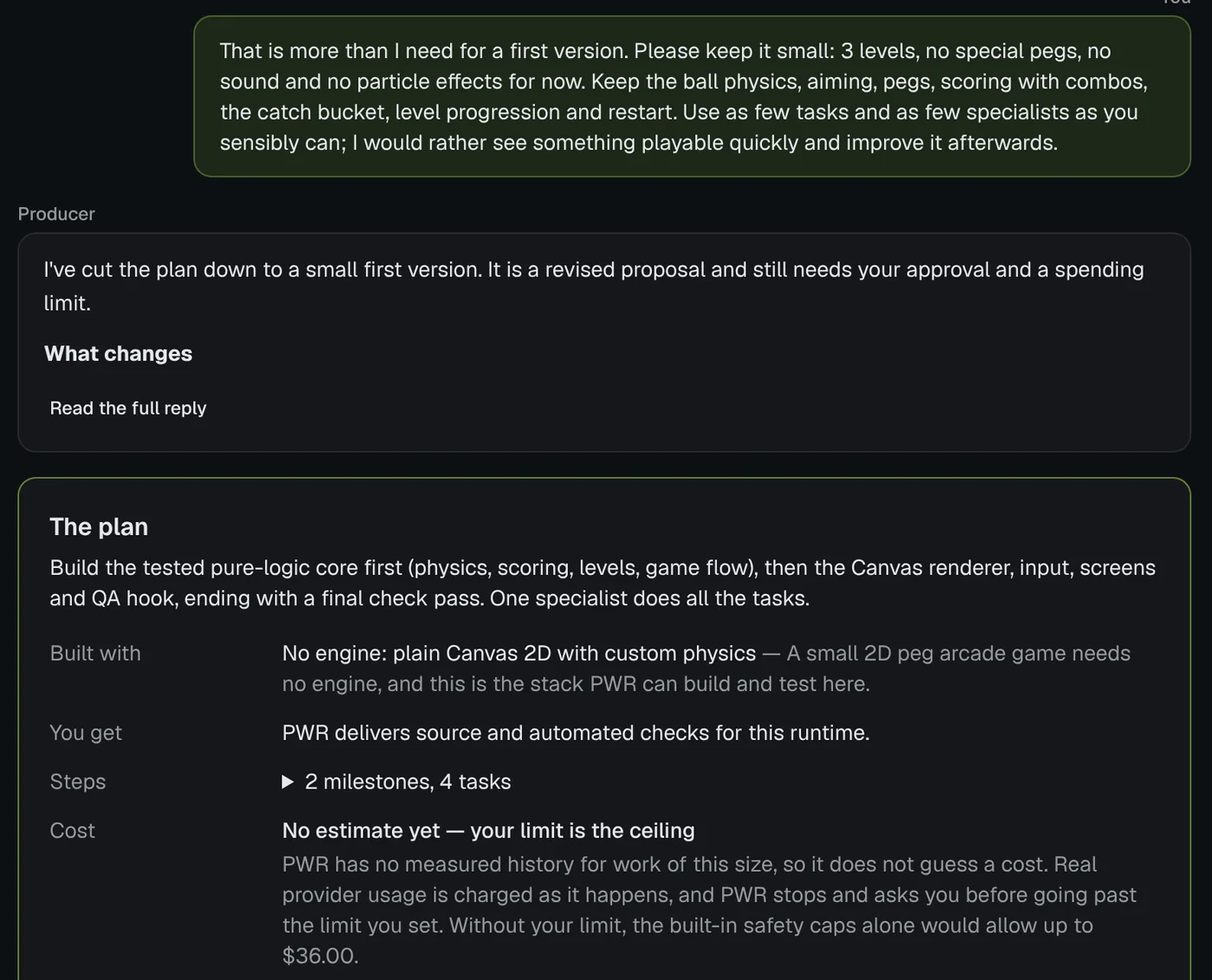
A plan, then a smaller plan
The Producer wrote a specification and a plan. The customer asked for a smaller first version, and the Producer cut it to 2 milestones and 4 tasks. Nothing started until the customer approved it with a spending limit.
The revised plan awaiting approval. - 03
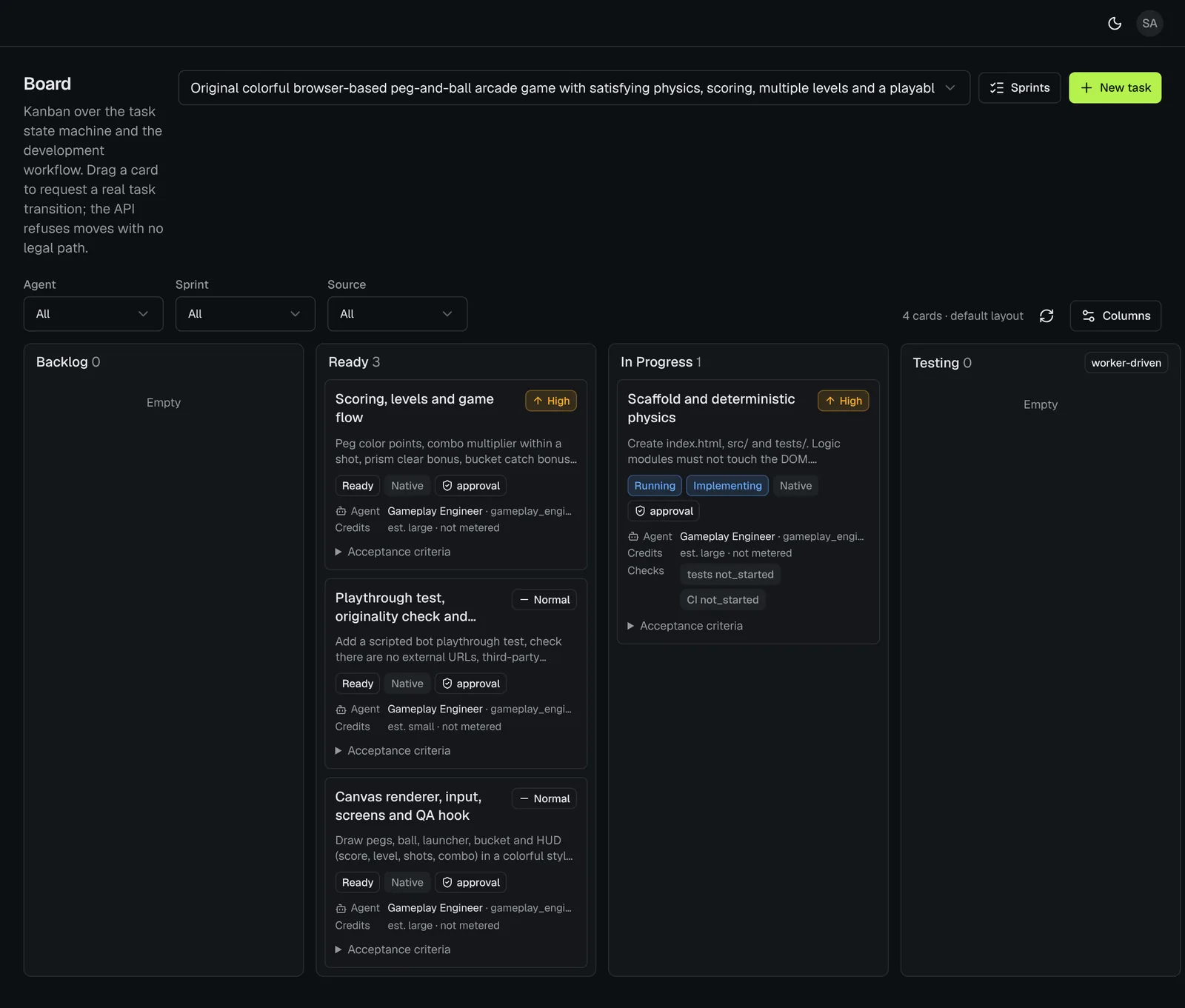
A team on a board
PWR assembled a Producer, an Architect, a Game specialist, QA and an Independent Reviewer. The Architect recorded 8 technical decisions; the specialist implemented the tasks in an isolated container.
The four tasks on the board during the build. - 04
QA said no, four times
QA rejected one task once and another three times before they passed. On the last one PWR stopped and asked the customer, who chose to try once more with guidance. An independent reviewer then checked every task, and a headless browser loaded and played the result at desktop and mobile sizes.
- 05
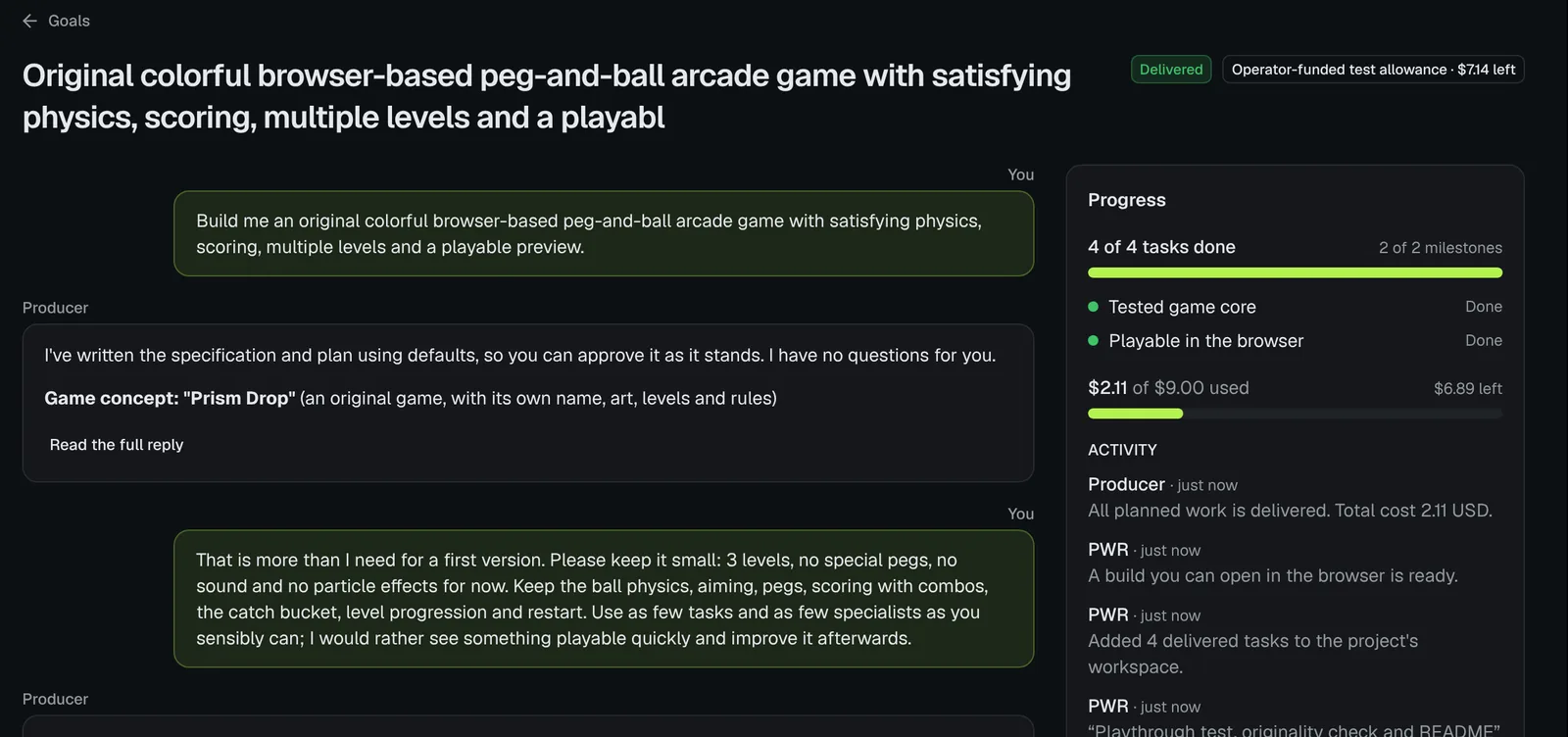
Delivered
The customer accepted the work: 19 files of source and a static bundle that opens in a browser.
The delivered goal, with the spending against the approved limit. - 06
Feedback, then a revision
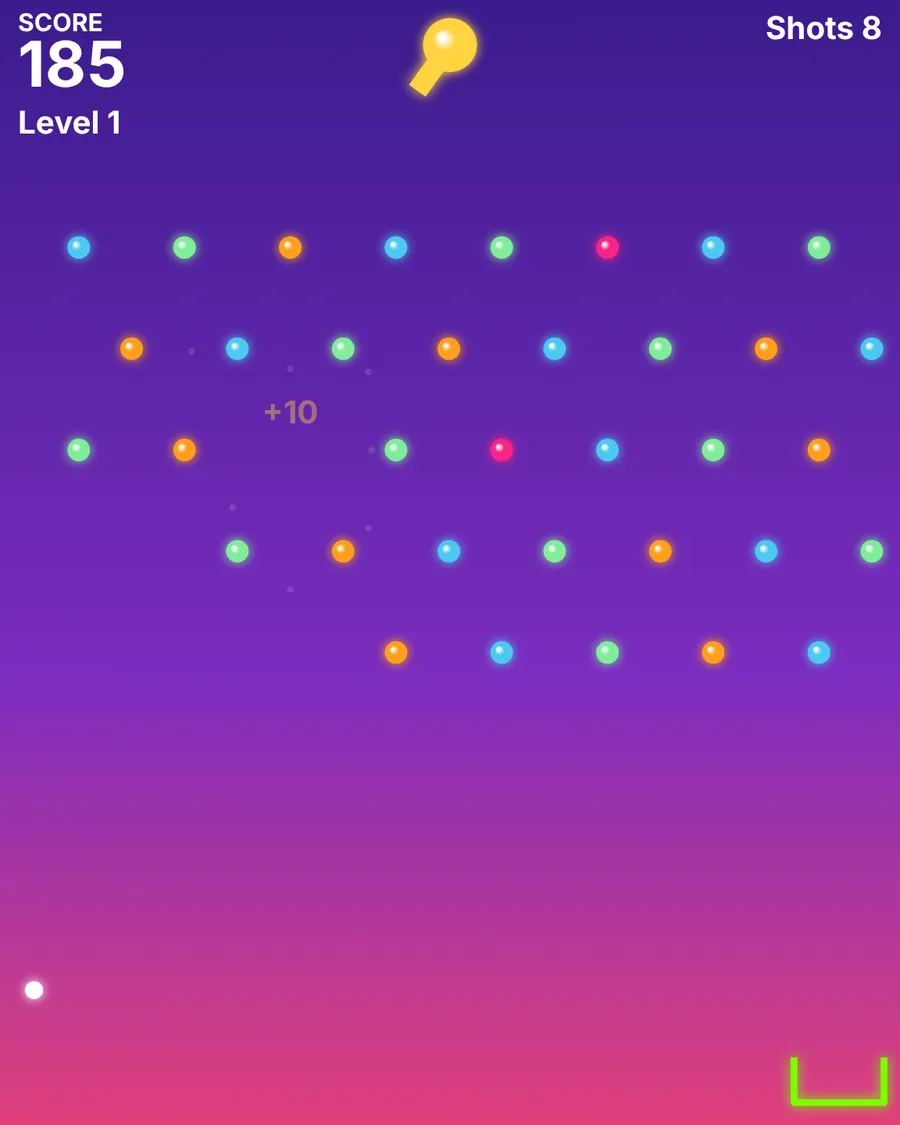
The customer sent four changes in one message. The Producer turned them into one follow-up task and pointed out that one of them reversed an earlier instruction. The revision passed QA and review in one cycle and was delivered for a further $0.36.
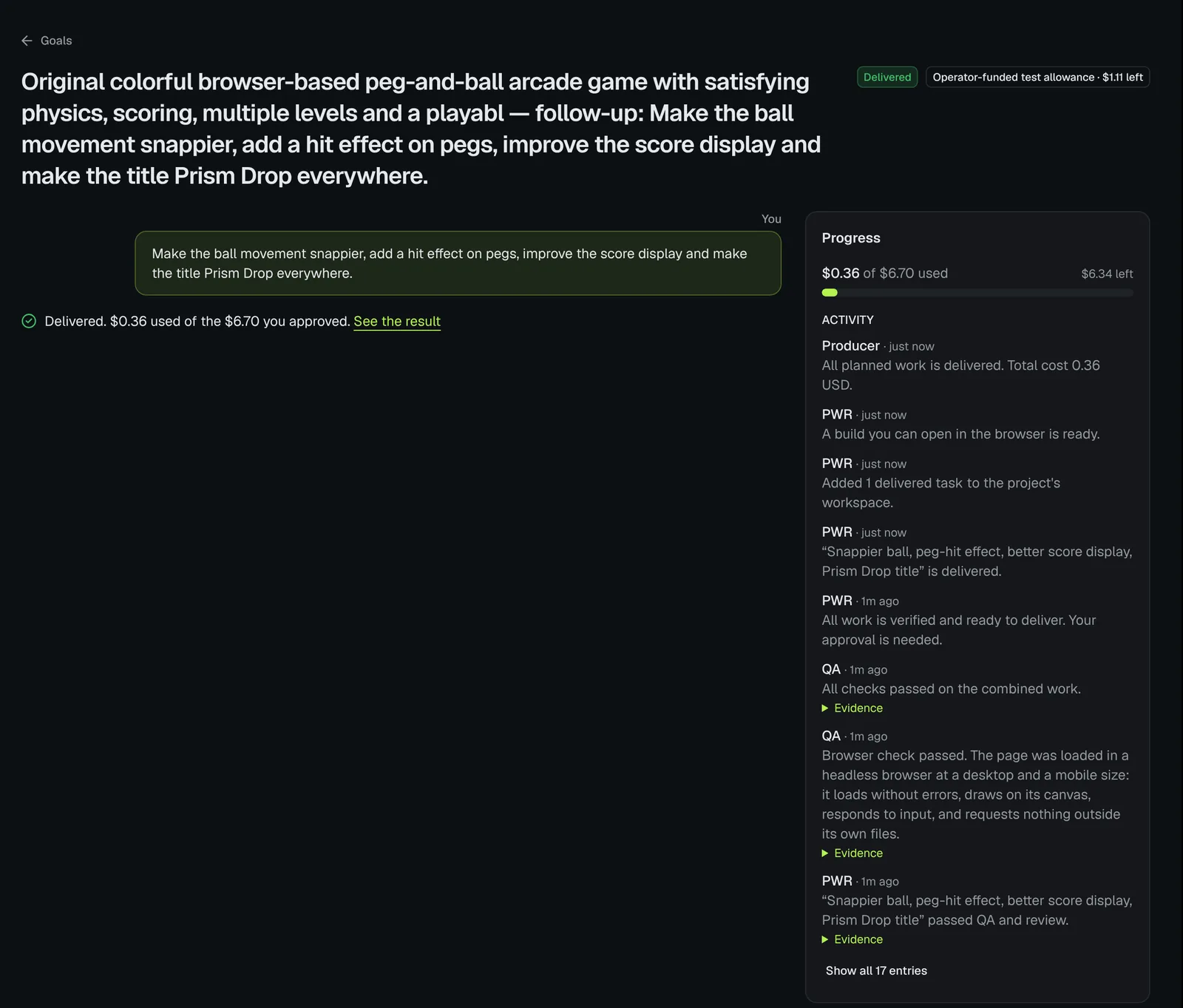
The feedback revision, delivered.
The game
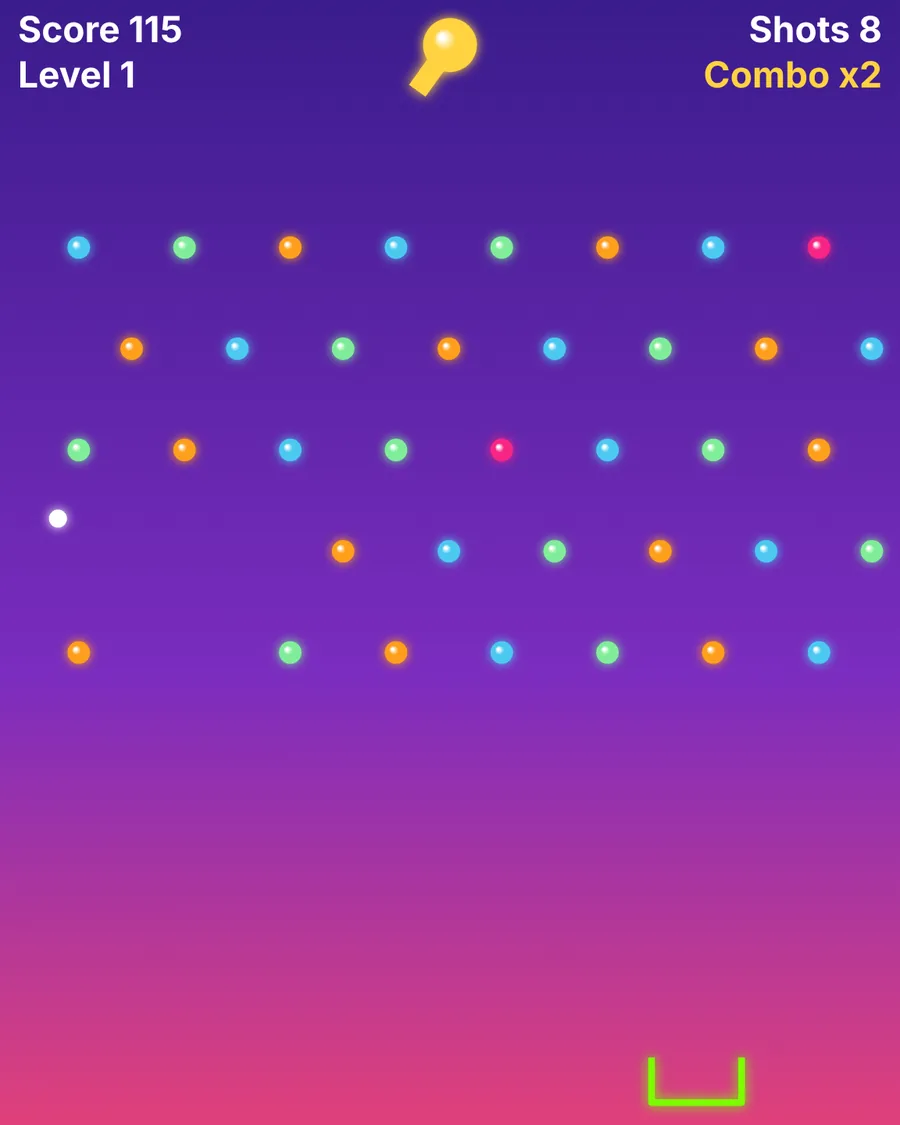
Prism Drop, as delivered and after the revision. These are the delivered files opened in a browser, not a mock-up.
The team
Coding assistants help you write code. PWR runs the development.
Each role is a separate agent with its own instructions and tools, coordinated by the Producer. These are the roles PWR assembled for the build above.
Producer
Talks with you, writes the requirements and the plan, reports progress and turns your feedback into work.
Architect
Decides the technical approach before implementation starts and records each decision.
Specialists
Implement the tasks in an isolated workspace. The plan decides which specialists are needed.
QA
Runs the checks, rejects work that does not meet its criteria and sends it back to be fixed.
Independent Reviewer
Reviews each piece of work separately from the agent that wrote it.
What you can build
Software applications and games.
Each use is labelled with how far it has been proven. We would rather under-claim than surprise you.
Game development
BetaOriginal browser games, gameplay prototypes and interactive experiences, built from a description and delivered as source and a playable bundle.
Shown on staging: a browser game built, tested, reviewed and revised. Hosted Unity and Unreal builds are not available.
Software applications
BetaWeb applications, internal tools, dashboards and prototypes, within the environments PWR can build and test.
The same workflow as the game build. A full application build has not been recorded yet.
Startups and founders
BetaTurn a product idea into a working prototype with a written plan, structured development and testing, instead of a pile of generated code.
Uses the build workflow above. No customer result is claimed.
Developers and teams
BetaHand over a defined development task in an existing codebase and keep visibility, review and approval over what changes.
Shown once on PWR's own repository. Delivery through the GitHub integration has not been verified end to end.
Iterative development
BetaAsk for changes to something PWR already built. The Producer turns the feedback into work, and it is implemented and validated again.
Shown on staging: one feedback message became one follow-up task, delivered after QA and review.
Control
Autonomous in the work. Yours in the decisions.
Agents do the development. You decide what is built, what it may cost and whether it is accepted.
Nothing starts without your approval
You see the scope and the tasks first. Work begins only when you approve the plan.
A spending limit that is enforced
You set the most a project may spend. At the limit PWR pauses, keeps the work and asks you.
Work runs in isolation
Agents implement inside a sandboxed container, not on your machine and not alongside other customers' projects.
The project remembers
Requirements, decisions, findings and spending are kept with the project, so you can come back and ask where things stand.
Read the security overview for what is implemented, what is still being verified, and what we do not claim.
Pricing
Plans for one person up to a whole studio.
Every paid plan runs the same agents and models. Plans differ by monthly credit allowance, parallel runs, projects and team size. Usage is metered; no plan is unlimited.
Starter
Pro
Studio
Team
Business
Enterprise
Contact sales
Prices and included credits are published when billing opens.
Compare plansYour idea. Your AI development team. Working software.
Describe what you want to build. PWR plans, builds, tests and reviews it, and you approve each step that matters.